License: CC-BY-NC-SA 4.0
Author: Murilo M. Marinho (murilo
I found an issue
Thank you! Please report it at https://
Package installation
%%capture
%pip install numpy matplotlibImports
%matplotlib inline
import numpy as np
import matplotlib.pyplot as plt
from math import pi, sin, cosDefinition(s)
The function(s) defined below are valid for all solutions.
def damped_pseudo_inverse(A: np.array, damping: float = 0.01):
    """Calculates the damped pseudo inverse of A"""
    if damping == 0:
        raise Exception(f"Damping is {damping} but should be different from zero")

    return A.T @ np.linalg.inv(A @ A.T + (damping ** 2) * np.eye(A.shape[0]))
PP Robot
Suppose that we have a PP robot defined by the following transformations:
a translation of along the axis of the base frame.
a rotation of 90 degrees with respect to the current frame.
a translation of along the axis of the current frame.
For FKM and Jacobian calculation, see lesson 4.
For the control parameters, see lesson 5.
def get_error(x, xd):
    return x - xd

def planar_robot_pp_fkm(q: np.array) -> np.array:
    q_0 = q[0]
    q_1 = q[1]
    return np.array([q_0,
                     q_1,
                     pi/2.0])

def planar_robot_pp_jacobian(q):
    # We can leave the parameter `q` for compatibility, but it's not used for this robot.
    return np.array(
        [[1, 0],
         [0, 1],
         [0, 0]]
    )

eta = 1 # Control gain
T = 0.001 # Sampling time
# A desired task-space value
xd = np.array([2.0,
               2.0,
               pi/10])
print(f"xd = {xd}")

# Lists to store the value of each control iteration
x_tilde_norm_list = []
t_list = []
u_norm_list = []

# Starting conditions
t = 0
q_0 = 0.0
q_1 = 0.0
q = np.array([q_0,
              q_1])

# Control for 10 seconds
while t < 10:
    x = planar_robot_pp_fkm(q)
    x_tilde = get_error(x, xd)
    J = planar_robot_pp_jacobian(q)
    J_inv = damped_pseudo_inverse(J)
    u = -eta * J_inv @ x_tilde

    ## Store values
    x_tilde_norm_list.append(np.linalg.norm(x_tilde))
    t_list.append(t)
    u_norm_list.append(np.linalg.norm(u))

    ## Variable updated for the next loop
    q = q + u * T
    t = t + T

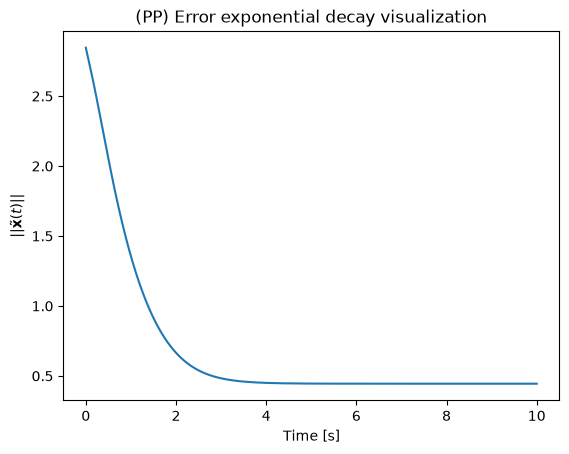
plt.plot(t_list,x_tilde_norm_list, label=f"$\\eta$={eta}")

plt.title('(PP) Error exponential decay visualization')
plt.xlabel("Time [s]")
plt.ylabel("$||\\tilde{ \\bf{x} } (t) ||$")
plt.show()
xd = [2. 2. 0.31415927]
RP Robot
Suppose that we have a RP robot defined by the following transformations:
a rotation of of the base frame.
a translation of along the axis of the current frame.
For FKM and Jacobian calculation process, see lesson 4.
For the control parameters, see lesson 5.
def get_error(x, xd):
    return x - xd

def planar_robot_rp_fkm(q: np.array) -> np.array:
    q_0 = q[0]
    q_1 = q[1]
    return np.array([q_1*cos(q_0),
                     q_1*sin(q_0),
                     q_0])

def planar_robot_rp_jacobian(q):
    q_0 = q[0]
    q_1 = q[1]
    return np.array(
        [[-q_1*sin(q_0), cos(q_0)],
         [ q_1*cos(q_0), sin(q_0)],
         [ 1,            0]]
    )

eta = 1 # Control gain
T = 0.001 # Sampling time
# A desired task-space value
xd = np.array([2.0,
               2.0,
               pi/10])
print(f"xd = {xd}")

# Lists to store the value of each control iteration
x_tilde_norm_list = []
t_list = []
u_norm_list = []

# Starting conditions
t = 0
q_0 = 0.0
q_1 = 0.0
q = np.array([q_0,
              q_1])

# Control for 10 seconds
while t < 10:
    x = planar_robot_rp_fkm(q)
    x_tilde = get_error(x, xd)
    J = planar_robot_rp_jacobian(q)
    J_inv = damped_pseudo_inverse(J)
    u = -eta * J_inv @ x_tilde

    ## Store values
    x_tilde_norm_list.append(np.linalg.norm(x_tilde))
    t_list.append(t)
    u_norm_list.append(np.linalg.norm(u))

    ## Variable updated for the next loop
    q = q + u * T
    t = t + T

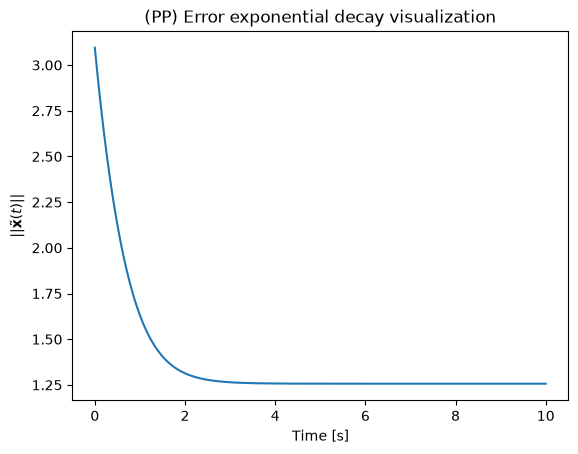
plt.plot(t_list,x_tilde_norm_list, label=f"$\\eta$={eta}")

plt.title('(PP) Error exponential decay visualization')
plt.xlabel("Time [s]")
plt.ylabel("$||\\tilde{ \\bf{x} } (t) ||$")
plt.show()
xd = [2. 2. 0.31415927]