Loading...
Searching...
No Matches
marinholab::sas::core::RobotDriver Class Referenceabstract
Abstract interface for robot hardware drivers. More...
#include <sas_robot_driver.hpp>
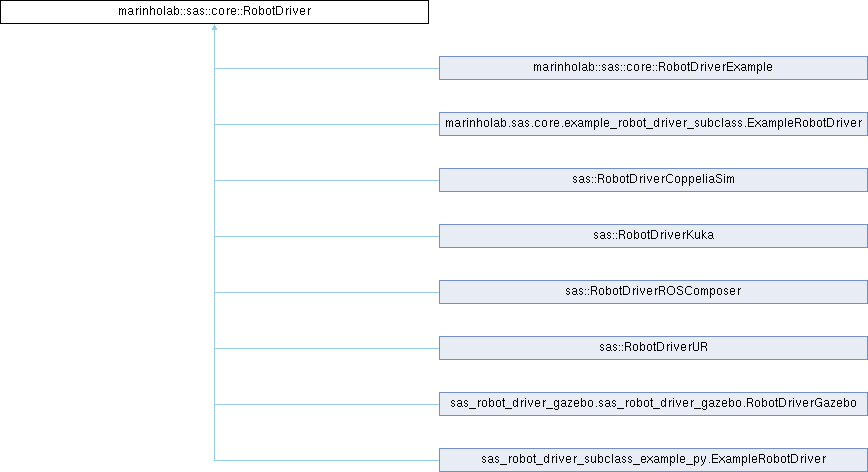
Inheritance diagram for marinholab::sas::core::RobotDriver:
Public Types | |
| enum class | Functionality { None =0 , PositionControl , VelocityControl , ForceControl , Homing , ClearPositions , Watchdog } |
| Enumeration of optional driver functionalities. | |
Public Member Functions | |
| virtual | ~RobotDriver () |
| Virtual destructor for RobotDriver. | |
| virtual Eigen::VectorXd | get_joint_positions ()=0 |
| Get current joint positions. | |
| virtual void | set_target_joint_positions (const Eigen::VectorXd &set_target_joint_positions_rad)=0 |
| Set target joint positions. | |
| virtual Eigen::VectorXd | get_joint_velocities () |
| Get current joint velocities. | |
| virtual void | set_target_joint_velocities (const Eigen::VectorXd &set_target_joint_velocities) |
| Set target joint velocities. | |
| virtual Eigen::VectorXd | get_joint_torques () |
| Get current joint torques. | |
| virtual void | set_target_joint_torques (const Eigen::VectorXd &set_target_joint_torques) |
| Set target joint torques. | |
| virtual std::tuple< Eigen::VectorXd, Eigen::VectorXd > | get_joint_limits () |
| Get joint limits (min, max). | |
| virtual void | set_joint_limits (const std::tuple< Eigen::VectorXd, Eigen::VectorXd > &joint_limits) |
| Set joint limits (min, max). | |
| void | watchdog_start (const std::chrono::nanoseconds &period) |
| Start the watchdog thread with the given period. | |
| void | watchdog_trigger (const std::chrono::time_point< std::chrono::system_clock, std::chrono::nanoseconds > &time_point_from_the_client, const std::chrono::time_point< std::chrono::system_clock, std::chrono::nanoseconds > &time_point_from_the_server, const bool &status) |
| Trigger the watchdog with timestamps from client/server and the current status. | |
| void | watchdog_set_maximum_acceptable_delay (const double &max_acceptable_delay) |
| Set the maximum acceptable delay for the watchdog (seconds). | |
| void | check_for_watchdog_exceptions () |
| Check for exceptions thrown by the watchdog thread and rethrow if present. | |
| virtual void | connect ()=0 |
| Connect to the underlying robot/hardware. | |
| virtual void | disconnect ()=0 |
| Disconnect from the underlying robot/hardware. | |
| virtual void | initialize ()=0 |
| Initialize the driver resources. | |
| virtual void | deinitialize ()=0 |
| Deinitialize the driver resources. | |
| void | set_control_loop_callback (std::function< void()> callback) |
| Set the control loop callback function. | |
| void | execute_control_loop_callback () |
| Execute the control loop callback if it has been set. | |
| bool | control_loop_callback_is_set () |
| Check if a control loop callback has been set. | |
Protected Member Functions | |
| void | _watchdog_thread_function () |
| RobotDriver::_watchdog_thread_function throws an exception if the elapsed time since the last trigger exceeds the specified period. | |
| RobotDriver (const std::shared_ptr< ShutdownSignaler > &shutdown_signaler_) | |
| RobotDriver (std::atomic_bool *break_loops) | |
| RobotDriver (const RobotDriver &)=delete | |
Protected Attributes | |
| std::atomic_bool * | break_loops_ |
| std::shared_ptr< ShutdownSignaler > | shutdown_signaler_ |
| std::tuple< Eigen::VectorXd, Eigen::VectorXd > | joint_limits_ |
| Eigen::VectorXd | joint_velocities_ |
| Eigen::VectorXd | joint_torques_ |
| std::unique_ptr< marinholab::sas::core::Clock > | clock_ |
| std::unique_ptr< std::thread > | watchdog_thread_ |
| std::chrono::time_point< std::chrono::system_clock, std::chrono::nanoseconds > | time_point_from_the_client_ |
| std::chrono::time_point< std::chrono::system_clock, std::chrono::nanoseconds > | time_point_from_the_server_ |
| bool | watchdog_status_ |
| std::mutex | mutex_watchdog_ |
| double | max_acceptable_delay_ = 0.1 |
| double | watchdog_period_ |
| std::exception_ptr | watchdog_exception_ {nullptr} |
| std::mutex | watchdog_exception_mutex_ |
| std::function< void()> | control_loop_callback_ |
Detailed Description
Abstract interface for robot hardware drivers.
RobotDriver declares the virtual API that concrete drivers must implement to interact with robot hardware.
Member Function Documentation
◆ check_for_watchdog_exceptions()
| void marinholab::sas::core::RobotDriver::check_for_watchdog_exceptions | ( | ) |
Check for exceptions thrown by the watchdog thread and rethrow if present.
RobotDriver::check_for_watchdog_exceptions this method rethrows any exception thrown in the watchdog thread control loop.
- Exceptions
-
std::runtime_error if the watchdog thread detected a timing or status error std::exception rethrows any exception captured from the watchdog thread
◆ connect()
|
pure virtual |
Connect to the underlying robot/hardware.
Implemented in marinholab::sas::core::RobotDriverExample, sas::RobotDriverCoppeliaSim, sas::RobotDriverKuka, sas::RobotDriverROSComposer, and sas::RobotDriverUR.
◆ control_loop_callback_is_set()
| bool marinholab::sas::core::RobotDriver::control_loop_callback_is_set | ( | ) |
Check if a control loop callback has been set.
- Returns
- true if a callback has been set, false otherwise
◆ deinitialize()
|
pure virtual |
Deinitialize the driver resources.
Implemented in marinholab::sas::core::RobotDriverExample, sas::RobotDriverCoppeliaSim, sas::RobotDriverKuka, sas::RobotDriverROSComposer, and sas::RobotDriverUR.
◆ disconnect()
|
pure virtual |
Disconnect from the underlying robot/hardware.
Implemented in marinholab::sas::core::RobotDriverExample, sas::RobotDriverCoppeliaSim, sas::RobotDriverKuka, sas::RobotDriverROSComposer, and sas::RobotDriverUR.
◆ execute_control_loop_callback()
| void marinholab::sas::core::RobotDriver::execute_control_loop_callback | ( | ) |
Execute the control loop callback if it has been set.
This method should be called by RobotDriverROS or any other class that runs the control loop. It will execute the callback that was set by the concrete RobotDriver implementation.
◆ get_joint_limits()
|
virtual |
Get joint limits (min, max).
- Returns
- Tuple of (min_limits, max_limits)
Reimplemented in sas::RobotDriverCoppeliaSim, and sas::RobotDriverROSComposer.
◆ get_joint_positions()
|
pure virtual |
Get current joint positions.
- Returns
- Vector of joint positions (radians)
Implemented in marinholab::sas::core::RobotDriverExample, sas::RobotDriverCoppeliaSim, sas::RobotDriverKuka, sas::RobotDriverROSComposer, and sas::RobotDriverUR.
◆ get_joint_torques()
|
virtual |
Get current joint torques.
- Returns
- Vector of joint torques
- Exceptions
-
std::runtime_error if the default implementation is called (not implemented by derived driver)
Reimplemented in sas::RobotDriverKuka.
◆ get_joint_velocities()
|
virtual |
Get current joint velocities.
- Returns
- Vector of joint velocities
- Exceptions
-
std::runtime_error if the default implementation is called (not implemented by derived driver)
Reimplemented in sas::RobotDriverUR.
◆ initialize()
|
pure virtual |
Initialize the driver resources.
Implemented in marinholab::sas::core::RobotDriverExample, sas::RobotDriverCoppeliaSim, sas::RobotDriverKuka, sas::RobotDriverROSComposer, and sas::RobotDriverUR.
◆ set_control_loop_callback()
| void marinholab::sas::core::RobotDriver::set_control_loop_callback | ( | std::function< void()> | callback | ) |
Set the control loop callback function.
RobotDriver::set_control_loop_callback.
- Parameters
-
callback The callback function to be executed in the control loop callback
◆ set_joint_limits()
|
virtual |
Set joint limits (min, max).
- Parameters
-
joint_limits Tuple of (min_limits, max_limits)
Reimplemented in sas::RobotDriverROSComposer.
◆ set_target_joint_positions()
|
pure virtual |
Set target joint positions.
- Parameters
-
set_target_joint_positions_rad Target joint positions (radians)
Implemented in marinholab::sas::core::RobotDriverExample, sas::RobotDriverCoppeliaSim, sas::RobotDriverKuka, sas::RobotDriverROSComposer, and sas::RobotDriverUR.
◆ set_target_joint_torques()
|
virtual |
Set target joint torques.
- Parameters
-
set_target_joint_torques Target joint torques
- Exceptions
-
std::runtime_error if the default implementation is called (not implemented by derived driver)
◆ set_target_joint_velocities()
|
virtual |
Set target joint velocities.
- Parameters
-
set_target_joint_velocities Target joint velocities
- Exceptions
-
std::runtime_error if the default implementation is called (not implemented by derived driver)
◆ watchdog_set_maximum_acceptable_delay()
| void marinholab::sas::core::RobotDriver::watchdog_set_maximum_acceptable_delay | ( | const double & | max_acceptable_delay | ) |
Set the maximum acceptable delay for the watchdog (seconds).
RobotDriver::watchdog_set_maximum_acceptable_delay sets the maximum acceptable clock skew to check the synchronization or potential delays between the time point of watchdog signal sent by the client and the time point when the watchdog signal was received.
- Parameters
-
max_acceptable_delay Maximum delay in seconds max_acceptable_delay
◆ watchdog_start()
| void marinholab::sas::core::RobotDriver::watchdog_start | ( | const std::chrono::nanoseconds & | period | ) |
Start the watchdog thread with the given period.
RobotDriver::watchdog_start starts the watchdog thread.
- Parameters
-
period Watchdog period as nanoseconds period The period of time.
◆ watchdog_trigger()
| void marinholab::sas::core::RobotDriver::watchdog_trigger | ( | const std::chrono::time_point< std::chrono::system_clock, std::chrono::nanoseconds > & | time_point_from_the_client, |
| const std::chrono::time_point< std::chrono::system_clock, std::chrono::nanoseconds > & | time_point_from_the_server, | ||
| const bool & | status ) |
Trigger the watchdog with timestamps from client/server and the current status.
RobotDriver::watchdog_trigger updates the trigger signal.
- Parameters
-
time_point_from_the_client Time point provided by the client time_point_from_the_server Time point provided by the server status Current watchdog status flag time_point_from_the_client This time point corresponds to the moment the signal was sent, as recorded by the client computer's clock. time_point_from_the_server The time point when the watchdog signal was received. This time point uses the computer's clock on which the server (robot) is running. status The desired status. If false, the driver is going to stop.
The documentation for this class was generated from the following files:
- sas_cpp/include/marinholab/sas/core/sas_robot_driver.hpp
- sas_cpp/src/sas_robot_driver.cpp